


A zero-dependency CLI wrapper that detects and repairs missing environment variables before your app starts.

- Installation
- Quick Start
- Quick Demo
- Features
- How It Works
- Works With
- Smart Type Validation
- Optional Variables
- FAQ
- Comparison
- Command Reference
- Options
- Multi-Environment Support
- Configuration
- CI/CD Integration
- Contributing
- License
Stop crashing your app because your .env is out of sync with .env.example. envrepair compares your active .env against the template, repairs missing variables interactively, then launches your command while preserving comments, spacing, blank lines, and ordering.
Install envrepair as a development dependency so it is available to all team members after npm install:
# npm
npm install -D envrepair

# pnpm
pnpm add -D envrepair

# yarn
yarn add -D envrepair

# bun
bun add -d envrepair
Then, prepend your startup scripts in package.json:
"scripts": {
  "dev": "envrepair next dev"
}Install globally or run on-demand without a local installation:
# Install globally
npm install -g envrepair

# Or run instantly on demand
npx envrepair [command] # npm
bunx envrepair [command] # bunSimply prepend your normal development command with envrepair:
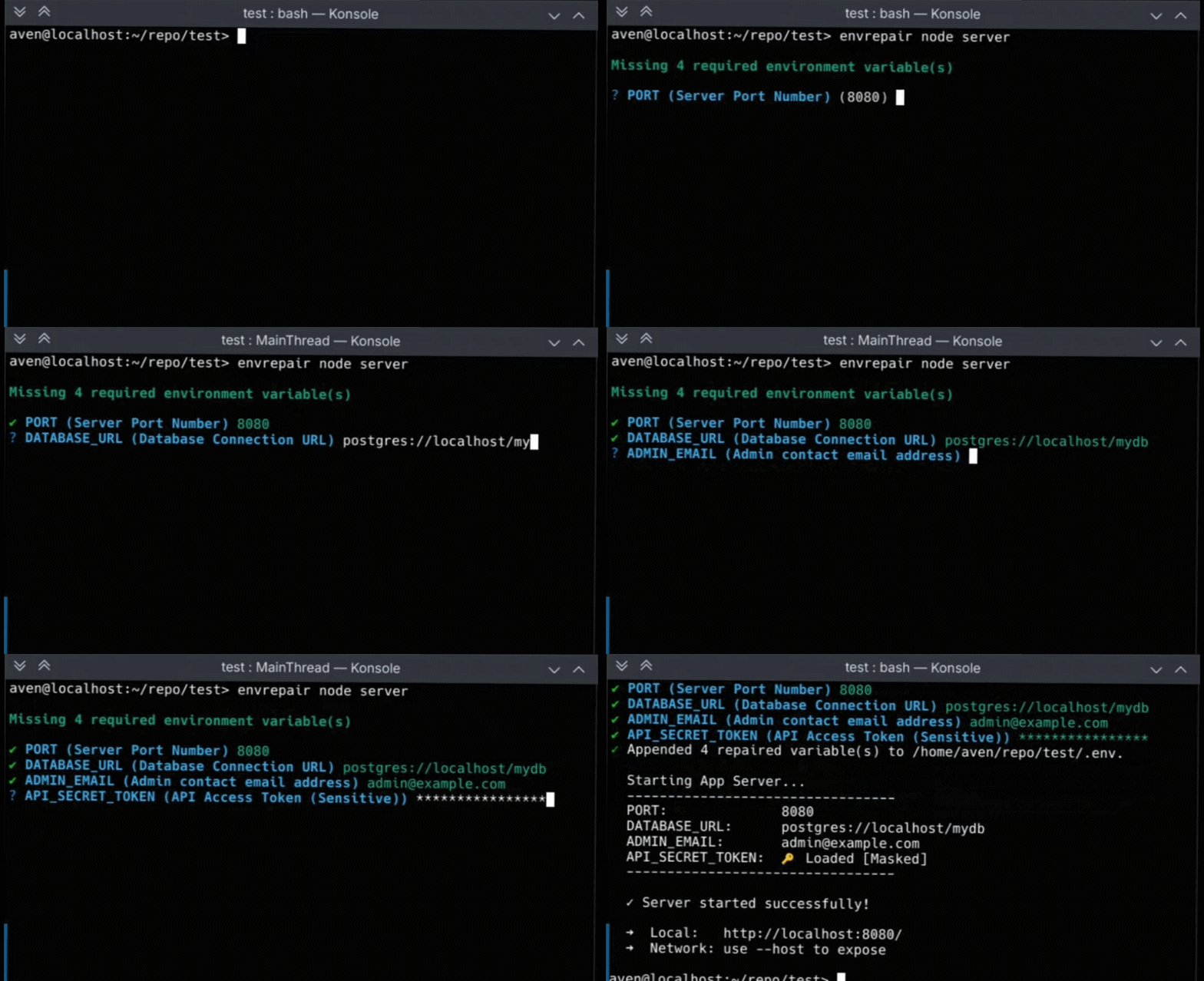
envrepair next devWhenever this command is run, envrepair will:
- Scan: Compares your local
.env(or.env.local) against.env.example. - Prompt & Validate: Interactively prompts you in the terminal for any missing keys, validating formats (like numbers, URLs, and emails) and masking sensitive credentials.
- Save: Appends the new variables to your
.envfile safely, preserving all of your existing comments, spacing, blank lines, and ordering. - Spawn: Instantly starts your target command (
next dev) as a transparent child process, passing signals (likeCtrl+C) and exit codes down to the shell.
Example session:
$ envrepair next dev

  Missing 2 required environment variable(s)

  DATABASE_URL
    Enter value: postgres://localhost/mydb

  API_SECRET_TOKEN
    Enter value (hidden): **************

  Appended 2 repaired variable(s) to .env.

> next dev
walkthrough.mp4
- Zero runtime dependencies. Bundles all internal CLI utilities (prompts, spawners, parsers) to ensure instant installs, minimal footprint, and zero supply chain vulnerability risks.
- Preserves your
.envexactly as you organized it. Comments, spacing, blank lines, and ordering stay intact. - Rejects invalid formats before they reach your application. Validates URLs, emails, numbers, and booleans in real-time using
# @typeannotations in your template. - Masks credentials automatically. Any key matching common sensitive patterns (PASSWORD, SECRET, TOKEN, KEY, etc.) is prompted with hidden input.
- Behaves like your original command.
Ctrl+C, exit codes, and terminal output work exactly as expected. - Automatically detects CI environments and exits with status 1 instead of hanging on interactive prompts.
.env.example
      │
      ▼
Compare with .env
      │
 Missing keys?
  ┌───┴───┐
  │       │
Prompt  Launch
  │
Update .env
  │
Launch
envrepair wraps any development command. It is not tied to a specific framework or runtime.
next dev      node server.js    vite
npm run dev   bun run dev       astro dev
nest start    remix dev         python manage.py runserver
Add # @type <type> annotations to .env.example to validate inputs during prompts:
# @type url
API_BASE_URL=
API_BASE_URL:
Enter value: localhost
❌ Invalid url
Enter value: https://api.example.com
✓
Supported validation types: string, number, boolean, url, email.
If your application has optional integrations (e.g. Sentry, Datadog) that are not strictly required for local development, mark them with a # @optional annotation in .env.example:
# @optional
SENTRY_DSN=
When marked optional:
envrepairwill not prompt you for this key during setup.- It will not cause diagnostic checks (
doctor,check) or CI runs to fail if it is missing or empty. - It will still be listed as
optionalindoctoranddiffcommand reports.
Does envrepair overwrite existing values?
No. Only variables that are missing from your .env are appended. Existing values are never modified.
Is this intended for production?
No. envrepair is designed for local development. In CI environments it skips prompts entirely and exits with status 1 if variables are missing, so it integrates cleanly into pipelines without hanging.
| Feature | envrepair |
dotenv-safe |
sync-dotenv |
envalid |
t3-env |
|---|---|---|---|---|---|
| Works as a CLI wrapper | ✅ Yes | ❌ No | ✅ Yes | ❌ No | ❌ No |
| Requires explicit validation definition | ❌ No | ❌ No | ❌ No | ✅ Yes | ✅ Yes |
| Auto-repairs missing variables | ✅ Yes | ❌ No | ❌ No | ❌ No | ❌ No |
| Interactive terminal prompts | ✅ Yes | ❌ No | ❌ No | ❌ No | ❌ No |
| Preserves comments, spacing, blank lines, and ordering | ✅ Yes | ❌ No | ❌ No | ❌ No | ❌ No |
| Input masking for secrets | ✅ Yes | ❌ No | ❌ No | ❌ No | ❌ No |
| Interactive typed input prompts | ✅ Yes | ❌ No | ❌ No | ❌ No | ❌ No |
| Schema-based validation (Zod, etc.) | ❌ No | ❌ No | ❌ No | ❌ No | ✅ Yes |
| Zero runtime dependencies | ✅ Yes | ❌ No | ❌ No | ❌ No | ❌ No |
Note
envrepair focuses on interactive environment setup and automatic repair before your application starts. Tools like t3-env and envalid focus on validating environment variables inside your application at runtime. These tools solve different problems and can be used together.
dotenv-safe intentionally fails fast, crashing your app if variables are missing and leaving you to find and fix them manually. envrepair guides you through repairing them interactively before your app ever starts.
These are runtime schema validators that live inside your application code. They are excellent at validating the types and shapes of variables your app depends on. envrepair works at the terminal layer before your app boots. They solve different problems and can be used together.
sync-dotenv automatically copies missing keys from .env.example into .env with empty values. It does not prompt you to fill them in, and it destroys your existing comments, spacing, and ordering in the process.
envrepair [target-command]Checks environment validity, runs interactive repair if needed, then runs the target command.
envrepair doctorOutputs a status report of synced, missing, and unused variables. Exits with status 1 if missing variables exist.
envrepair repairRuns the interactive terminal prompt flow to repair missing variables without starting a target process.
envrepair diff [--json]Shows differences between the active and template environment files. Outputs plain text or structured JSON.
envrepair checkRuns validation without interactive prompts, outputs differences in JSON, and exits with status 1 if variables are missing. Designed for CI/CD scripting.
envrepair initBootstraps a .env.example template by parsing an active .env file, preserving all spacing, comments, and structure while stripping the values of all variables.
-e, --env <path>: Path to the active env file.-x, --example <path>: Path to the template example file (defaults to.env.example).-m, --mode <name>: Specifies environment mode (e.g.development,production). Resolves cascading files matching the mode.-h, --help: Displays help information.
envrepair automatically supports multi-environment configurations using priority-based cascading resolution, mirroring standard frameworks (such as Next.js and Vite).
When you run envrepair without file path overrides, it scans and merges variables from existing active files in the following priority order (from lowest to highest):
.env(lowest priority).env.${mode}(if--modeis specified).env.local(local overrides; skipped if--mode testis used).env.${mode}.local(highest priority; if--modeis specified)
Any missing variables identified will be appended to the highest priority existing override file on disk (defaulting to .env or .env.${mode}).
You can customize envrepair defaults for your project directly inside your package.json file. This is highly useful if you store environment files in custom directories or use custom names.
Add an "envrepair" key to your package.json:
{
  "name": "your-project",
  "envrepair": {
    "env": [".env", ".env.local"],
    "example": ".env.template",
    "mode": "development"
  }
}env(string | string[]): Relative path or array of relative paths to the target environment files.example(string): Relative path to the template environment file (e.g..env.example,.env.template).mode(string): Default environment mode (e.g.development,production).
Note
Command line arguments (like -e, -x, or -m) will always override settings defined in package.json.
Important
Shell-less command execution: envrepair spawns target commands directly without a shell wrapper (similar to cross-env) to avoid command injection vulnerabilities and platform inconsistencies. Custom shell aliases or built-in terminal functions (e.g. shell-specific profiles) are not inherited by the runner.
In headless environments, envrepair skips prompts and exits with status 1 if variables are missing:
# Validates environment state and exits with 0 or 1.
envrepair checkContributions are welcome! Please check the Contributing Guidelines.
Distributed under the MIT License. See LICENSE for more details.